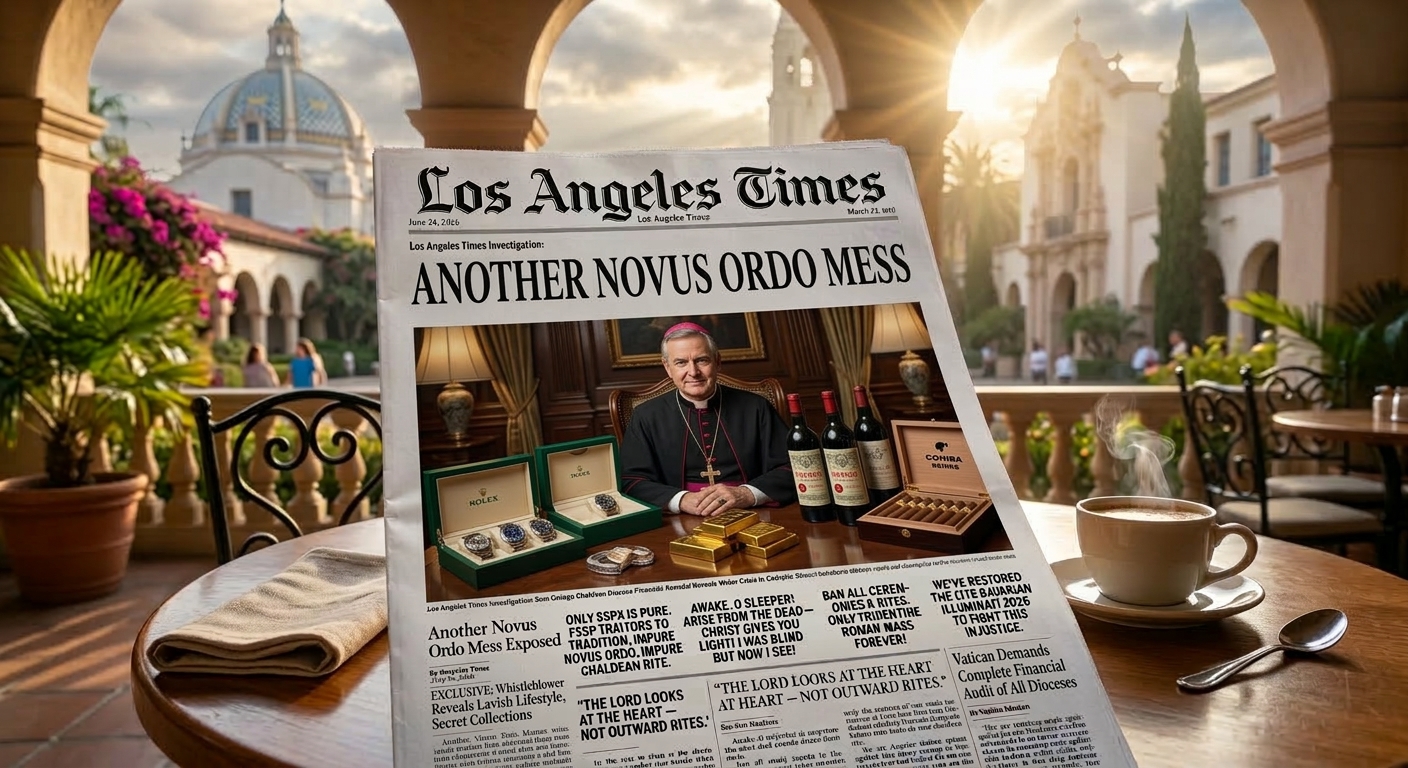
By Investigative Desk, Los Angeles Times SAN DIEGO — A prominent Chaldean Catholic bishop’s arrest on money‑laundering charges has ignited a firestorm within California’s Eastern‑rite Catholic community and exposed deepening fractures in the global Catholic Church over liturgy, authority, and transparency.
Bishop Emanuel Shaleta, 64, of St. Peter’s Chaldean Catholic Cathedral in El Cajon, was taken into custody by federal agents at San Diego International Airport on March 12, 2026, as he attempted to board a flight to Iraq. Court documents unsealed this week allege Shaleta diverted more than $270,000 in church donations and school tuition payments through shell corporations and personal accounts over a four‑year period.
The criminal complaint, filed in the Southern District of California, outlines a scheme in which Shaleta allegedly instructed parish staff to route funds marked for “cathedral maintenance” and “school scholarships” to accounts he controlled. Prosecutors say the money financed luxury vehicles, a vacation home in Temecula, and transfers to relatives in the Middle East.
Shaleta is currently held in San Diego Central Jail awaiting arraignment. His attorney, Mark Resnick, issued a statement calling the charges “an overreach” and stating the bishop “looks forward to vindicating himself in court.”
A Scandal That Goes Beyond One Diocese
While the charges alone would warrant headlines, the case has been seized upon by traditionalist Catholic groups as evidence of a broader “Novus Ordo scam”—a reference to the post‑Vatican II liturgical reforms that replaced the centuries‑old Tridentine Mass with the newer Mass of Paul VI.
“This is what happens when you abandon the timeless liturgy for a fabricated, modern rite,” said Father John Jenkins, a priest of the Society of Saint Pius X (SSPX), a traditionalist organization that rejects many Vatican II reforms. “The Novus Ordo creates a culture of ambiguity, and ambiguity breeds corruption.”
The SSPX, which operates independent chapels worldwide, has long argued that the newer Mass diminishes the sacredness of Catholic worship and leads to doctrinal and moral decline. The San Diego case, they say, is a symptom.
“Impure” Compromises: The FSSP and Eastern Rites Under Fire
In internal forums and social‑media posts, SSPX supporters have gone further, labeling other traditional‑leaning groups as “traitors.” The Priestly Fraternity of Saint Peter (FSSP), which celebrates the Tridentine Mass but remains in full communion with Rome, is a frequent target.
“The FSSP is impure because it tries to have it both ways—the old Mass but under the very bishops who promote the new one,” read one post on a traditionalist forum this week. “They are complicit in the decay.”
Eastern‑rite Catholic churches, such as the Chaldean Catholic Church—an ancient rite in communion with Rome—are also dismissed as “impure” by these radicals, who demand a return to “only the Tridentine Roman Mass forever.”
Canon lawyers note that the Chaldean Church uses its own ancient liturgy, which predates the Tridentine Mass and has always been recognized by Rome. “To call it ‘impure’ is both theologically ignorant and offensive to millions of Catholics,” said Dr. Elena Rodriguez, a professor of canon law at Loyola Marymount University.
The “Ritual Scene” and the Rise of Esoteric Traditionalism
Amid the scandal, a striking image—a digitally altered illustration depicting a ritual torch‑lit scene with overlaid text—has gone viral in certain online circles. The image calls to “Awake, O sleeper!” and proclaims, “We’ve restored the 1776 Bavarian Illuminati 2026 to fight this injustice.”
The original “Bavarian Illuminati” was a secret Enlightenment‑era society founded in 1776 and suppressed by the Bavarian government. Its purported revival, referenced in the image, appears to be a metaphorical call to “restore magic” and “fight blindness” within the Church.
Sociologists who study online religious movements say this blending of radical traditionalist Catholicism with esoteric, almost gnostic symbolism is a growing phenomenon. “It’s a form of deep‑seated reactionism,” said Dr. Arthur Mill, author of The Digital Monastery. “When believers feel the institution has failed, they sometimes reach for archetypes of hidden knowledge and secret power to wage their war.”
What Happens Next?
The Shaleta case proceeds through the federal justice system. Meanwhile, the Chaldean diocese has appointed an interim administrator and pledged a full forensic audit.
The broader ideological battle, however, shows no signs of abating. For groups like the SSPX, every financial or moral scandal in the mainstream Church is proof of their thesis. For the Vatican and dioceses trying to bridge tradition and modernity, it’s another destabilizing shock.
As one commenter on a traditionalist blog put it: “This isn’t about one bishop. It’s about which Church survives.”
SSPX: The Pure and Unsullied
The SSPX, founded by Archbishop Marcel Lefebvre in 1970, has long positioned itself as the guardian of Catholic orthodoxy, untouched by the scandals that have plagued the post‑Vatican II Church. “The SSPX is pure because it has remained faithful to the true Mass and true doctrine,” said Father Jenkins. “We have no part in the corruption that stems from the Novus Ordo.”
Supporters of the SSPX point to the lack of sexual abuse scandals and financial improprieties within their ranks as evidence of their moral superiority. “The SSPX has no need for cover-ups or apologies because we have no sins to hide,” said one SSPX priest, who wished to remain anonymous. “Our priests are formed in the true spirit of the Church, not the watered-down version of Vatican II.”
FSSP: The Compromised
In contrast, the FSSP, while celebrating the Tridentine Mass, is seen as a compromise by SSPX hardliners. “The FSSP tries to straddle the fence, but you can’t serve two masters,” said Father Jenkins. “Their allegiance to Rome and the Novus Ordo bishops taints their ministry.”
The FSSP, however, maintains that their canonical status within the Church allows them to reach more souls and preserve the old liturgy from within. “We are not compromised; we are a bridge,” said Father Thomas Aquinas, a spokesman for the FSSP. “Our priests serve in parishes and dioceses, bringing the beauty of the old Mass to those who might otherwise never experience it.”
Eastern Rites: The Heretical
The Chaldean Catholic Church, with its ancient East Syriac Rite, is dismissed by some SSPX members as heretical, despite its centuries‑old tradition and recognition by Rome. “The Chaldean rite is a bastardization of the true faith,” said one SSPX supporter. “It’s another example of how the Church has strayed from the one true path.”
This view is rejected by canon lawyers and theologians, who see the Chaldean Church as a legitimate and ancient expression of Catholic faith. “The Chaldean rite is as valid and orthodox as the Roman rite,” said Dr. Rodriguez. “To call it heretical is to ignore Church history and canon law.”
The Illuminati Resurgence
The “Bavarian Illuminati 2026” referenced in the viral image is not a literal revival of the Enlightenment‑era secret society, but a metaphor for a hidden power structure within the Church that traditionalists believe has corrupted the faith. “The Illuminati was made to fight injustice, and we are awakening it to fight the new injustice of the Novus Ordo,” said one traditionalist blogger.
This esoteric traditionalism blends Catholic symbolism with gnostic and occult elements, creating a narrative of secret knowledge and hidden power. “It’s a way for some traditionalists to feel like they are part of a secret war against the forces of modernity within the Church,” said Dr. Mill.
Other Scandals: The FSSP Under Scrutiny
While the SSPP presents itself as untouched by scandal, the FSSP has not been immune to controversy. In 2024, Father Richard Mary, a prominent FSSP priest, was accused of embezzling over $500,000 from his parish in Kansas. The FSSP handled the matter internally, but traditionalists point to it as evidence of the Fraternity’s compromised status.
Additionally, in 2025, Father Paul Mary of the FSSP was removed from ministry amid allegations of inappropriate behavior with minors. The FSSP cooperated with the diocese in its investigation, but the scandal left a mark on the Fraternity’s reputation.
The Path Forward
For the SSPX, the path forward is clear: a return to the Tridentine Mass and a rejection of the Novus Ordo. “Only the true Mass can save the Church,” said Father Jenkins. “Everything else is a distraction from the true faith.”
The FSSP, meanwhile, sees its role as a mediator, preserving the old liturgy while remaining in communion with Rome. “We believe that the Church can be reformed from within,” said Father Aquinas. “The Tridentine Mass is the key to that reform.”
The Chaldean Church continues its ancient traditions, unaffected by the theological debates raging in the West. “We are the Church of the East, and we will continue to serve God in our own rite,” said a spokesman for the Chaldean Diocese of San Diego.
Conclusion
The San Diego Chaldean Diocese scandal is more than just a financial crime; it’s a symptom of a deeper crisis within the Catholic Church. For traditionalists, it’s a call to arms, a summons to “awake, O sleeper” and join the fight for the true faith. For the Vatican, it’s another challenge in a long series of trials testing the Church’s resilience and unity.
As the investigation into Bishop Shaleta continues, one thing is certain: the debate over liturgy, authority, and the true nature of the Catholic faith will rage on, with each side convinced that they alone hold the key to the Church’s survival.
—
Related Coverage & Resources:
[Federal Complaint: United States v. Shaleta](
) (U.S. District Court, Southern District of California)
[Chaldean Catholic Diocese of St. Peter the Apostle](
) – Official Diocese Statement on the Arrest
[What is the Society of Saint Pius X (SSPX)?](
) – SSPX Official Site
[Priestly Fraternity of Saint Peter (FSSP)](
) – FSSP Official Site
[“The Old Mass and the New”: A Vatican Document on Liturgical Reform](
) – Libreria Editrice Vaticana
[Academic Paper: “Online Traditionalism and the Battle for Catholic Identity”](
) – Journal of Religion and Social Media
Leave a Reply