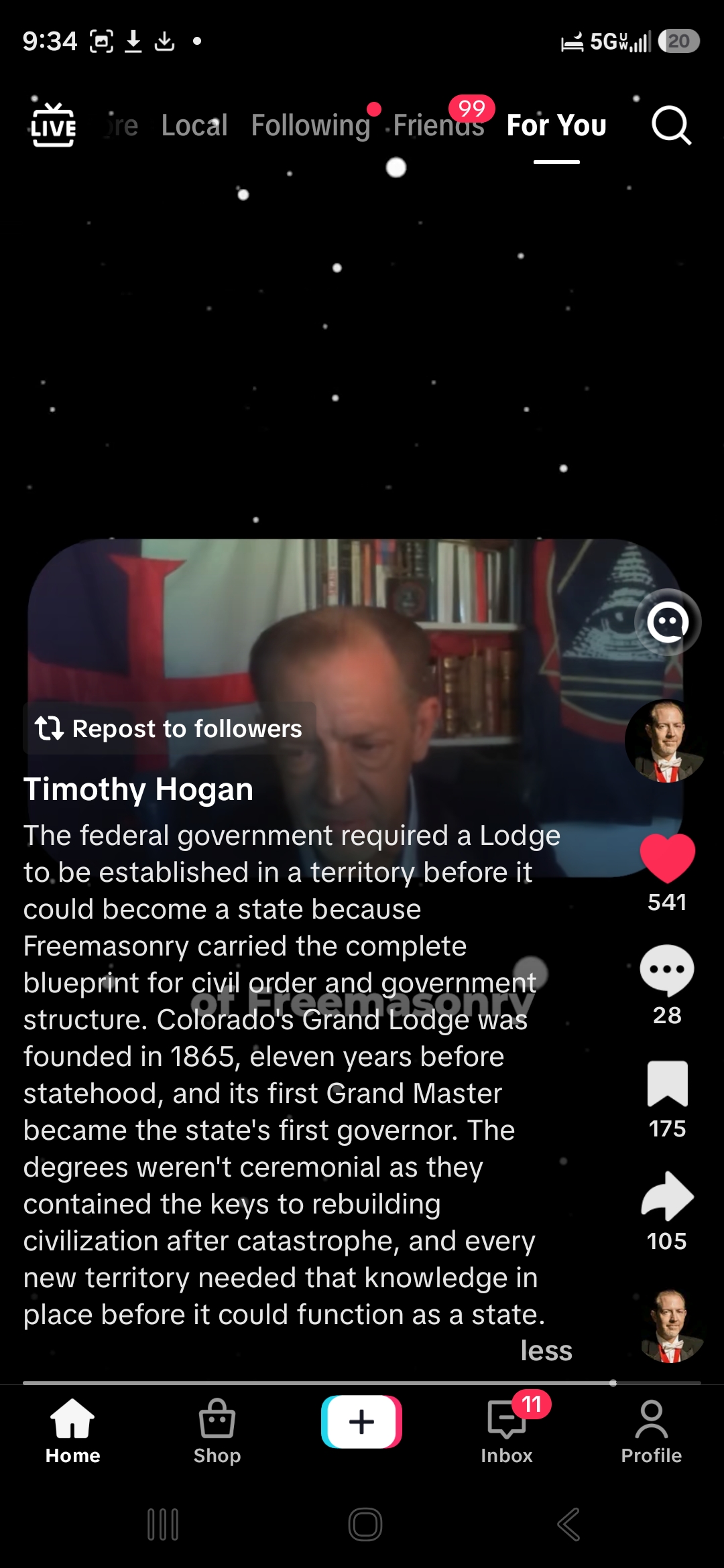
The claim in Timothy Hogan’s post is a mix of partial truths, exaggerations, and unsubstantiated conspiracy theory. It promotes a romanticized, esoteric view of Freemasonry as secretly essential to American governance, but it misrepresents history.
Accurate or partially accurate parts
- Colorado Grand Lodge timeline: The Grand Lodge of Colorado was organized on August 2, 1861 (not exactly 1865 as stated in some versions of the post; the screenshot and some reposts say 1865, but primary records confirm 1861). Colorado became a state on August 1, 1876 (“Centennial State”). So, roughly 15 years earlier, not precisely 11. Masonic lodges existed in the territory even earlier, with the first informal meetings in 1858 during the Gold Rush and charters from Kansas/Nebraska Grand Lodges.
- Freemasons in early Colorado leadership: Many prominent early Coloradans were Masons. Henry M. Teller (Grand Master in 1863) became one of Colorado’s first U.S. Senators and later Secretary of the Interior. Other Grand Masters or members held civic roles. James H. Peabody (Governor in 1903 and 1905) served as Grand Master of Colorado Masons in 1885 (at age 32, notably young). However, he was not the first governor, and no “first Grand Master” directly became the state’s first governor upon statehood. The first territorial governor (John Evans, 1862–1865) had Masonic ties, but the claim oversimplifies. John Chivington was the very first Grand Master (1861) but is infamous for the Sand Creek Massacre, not governorship.
- Masonic influence on civic life: Freemasonry was disproportionately represented among American elites, founders, and Western pioneers. Many signers of the Declaration/Constitution, presidents, and frontier leaders were Masons. Lodges often served as social/networking hubs in new settlements, promoting values like brotherhood, self-improvement, charity, and republican ideals (which overlapped with Enlightenment thought). The U.S. system draws from mixed sources, including classical republicanism, English common law, and some Masonic symbolic language (e.g., the eye/pyramid on the Great Seal, though its Masonic link is debated).
Inaccurate or misleading parts
- “The federal government required a Lodge… before it could become a state”: This is false. No law, congressional act, or constitutional requirement ever mandated a Masonic lodge for territorial statehood. Statehood is governed by Article IV, Section 3 of the U.S. Constitution: Congress admits new states, often after a territory drafts a constitution, holds a referendum, and meets population/governance thresholds. Requirements varied (e.g., enabling acts), but none involved Freemasonry. This is a recurring conspiracy trope with zero primary evidence from congressional records or territorial acts.
- “Freemasonry carried the complete blueprint for civil order and government structure”: Overstated. Masonic rituals and symbolism emphasize moral allegory, geometry, architecture, and Enlightenment ideals (liberty, equality under law, reason). Some Founders (Washington, Franklin, etc.) were Masons, and lodges fostered networks. But the U.S. Constitution’s core—separation of powers, checks/balances, federalism, Bill of Rights—draws primarily from Montesquieu, Locke, English common law, colonial experience, and classical sources (Rome, Greece). Not a “Masonic blueprint.” Degrees are symbolic/moral/initiatory, not literal governance manuals for “rebuilding civilization after catastrophe.” Hogan (a prominent esoteric lecturer, author on alchemy/Templars, and Grand Master in certain Templar/Martinist lines) often frames Masonry in grand, initiatory, almost mystical terms. This resonates in esoteric circles but isn’t mainstream Masonic history or U.S. founding scholarship.
- Implication of hidden control: The post suggests Masonry was a quasi-official prerequisite with secret “keys” to functioning government. In reality, while Masons were overrepresented in early America (due to their emphasis on education, networking, and civic virtue), so were non-Masons. Many territories/states formed without dominant Masonic influence. Conspiracy versions (Masons secretly run everything, degrees encode government plans) lack evidence and ignore that regular Freemasonry is a fraternal organization focused on ritual, charity, and personal development—not a shadow government.
Broader context on Timothy Hogan
Hogan is a legitimate, well-known figure in esoteric Masonry: author of books like The Alchemical Keys to Masonic Ritual, lecturer at Grand Lodges, involved in York Rite, Scottish Rite, and independent Templar/Martinist orders. He comes from a Colorado Masonic family and speaks frequently on symbolic, alchemical, and “hidden history” interpretations. His content (TikTok, podcasts, books) appeals to those interested in Western mystery traditions but often blends verifiable Masonic history with speculative/esoteric layers. The post is typical of his style—highlighting real overlaps while elevating them into a grand narrative of Masonry as civilization’s hidden architect.
Verdict: The Colorado-specific facts (Grand Lodge predating statehood + Masonic leaders in politics) have a kernel of truth and reflect how fraternal organizations helped build frontier communities. The core claim of a federal requirement and Masonry as the mandatory “complete blueprint” is not supported by history—it’s conspiratorial embellishment. Freemasonry influenced American civic culture (as did churches, political parties, and voluntary associations), but it did not secretly dictate state formation or hold exclusive “keys” to government.
This fits a pattern of viral Masonic/Templar content that mixes pride in the fraternity’s real contributions with myth-making. For accurate history, consult Grand Lodge of Colorado records or standard sources on Western expansion and the U.S. founding. If you have more context or another claim to check, share it.
Leave a Reply