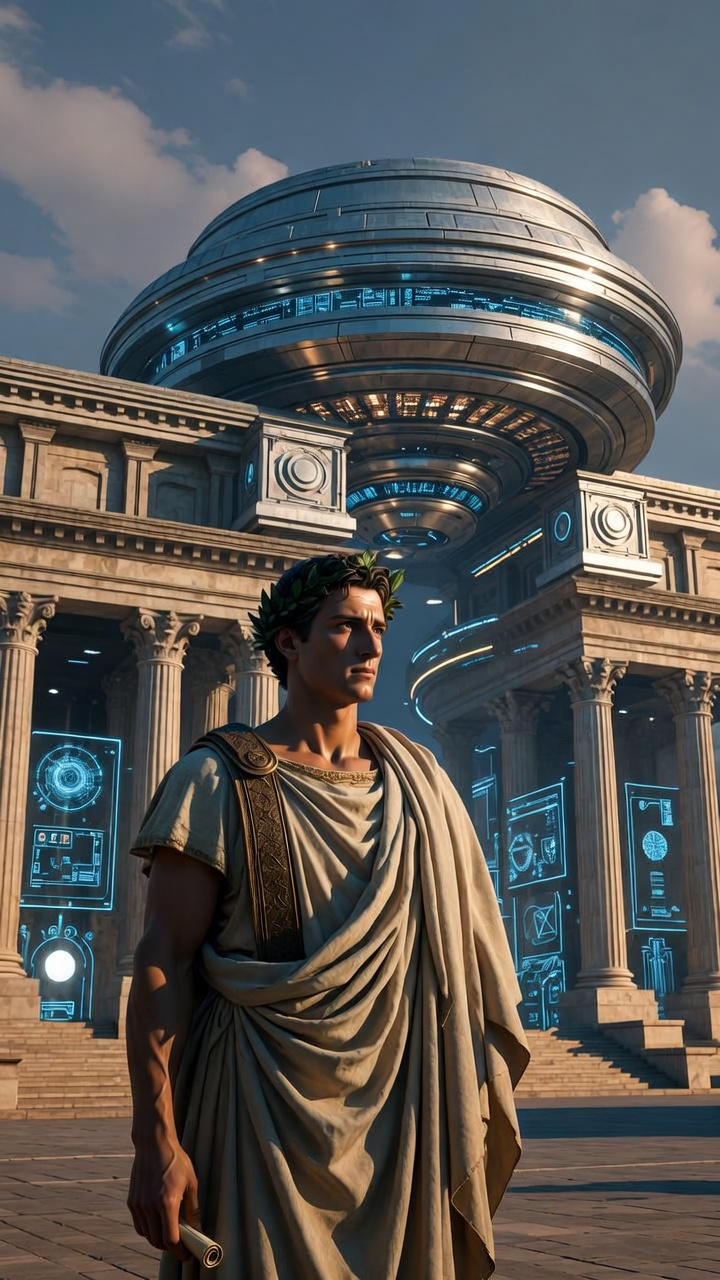
The Roman Ship: Julius Caesar’s Legion, Documents, and the Living Blueprint of the Roman Catholic Church
The Catholic Church is not a building, a modern movement, or a fragile institution drifting in hostile waters. It is a spacecraft—a living ship—engineered on the discipline, loyalty, documents, and expansionist vision of ancient Rome. Its captain was never meant to be a weak administrator swayed by fleeting movements. Its keel was laid by men like Gaius Julius Caesar (100 BC–44 BC), who forged the Roman Republic into a disciplined empire through conquest, ruthless reform, and unbreakable citizenship to Rome above all.
This is the investigative journey: tensor-physics style. We map the known (Caesar’s own commentaries, the Julian calendar we still use, the legion structure that conquered Gaul) against the unknown (how that same blueprint became the Vatican’s Holy See, the Swiss Guard as modern praetorian cohort, the global diocese network as provinces of a spiritual empire). We trace preservation of knowledge before 1208 AD, when monastic scribes copied the classics while the ship faced internal storms. We build the full blueprint—sacraments as initiations, hierarchy as ranks, laity as citizen-legionaries—and ask: if the Church had stayed true to Caesar’s ethics of sound mind, loyalty, and disciplined expansion, what would 2026 look like?
This is not nostalgia. It is the pattern. Real stories, real accounts. The journals demand it.
Part 1: Julius Caesar – The Architect of the Ship (Paraphrased and Expanded from Primary Sources)
Gaius Julius Caesar was born on July 12 or 13, 100 BC, into a patrician family claiming descent from Venus. He was no idle noble. By 81 BC he began military service; by the 50s BC he commanded legions like Legio XIII Gemina and launched the Gallic Wars (58–50 BC). In eight relentless campaigns he subdued the tribes of Gaul (modern France, Belgium, parts of Germany and Italy), extending Rome’s borders to the Atlantic and raiding Britain. A legion numbered roughly 5,000–6,000 men, organized into cohorts and centuries, armed with the gladius short sword, pilum throwing spear, scutum shield, and heavy armor. Caesar’s genius was logistics, engineering, and speed—building bridges across the Rhine, sieges at Alesia that trapped Vercingetorix, and rapid marches that outmaneuvered foes.
His own writings—Commentarii de Bello Gallico (The Gallic War) and De Bello Civili—are the ship’s logbooks: clear, first-person, propaganda-laced but factual records of strategy, supply lines, and command decisions. These survive because later scribes (many in Benedictine monasteries centuries later) copied them. Caesar crossed the Rubicon River in 49 BC with a legion, defying the Senate and igniting civil war against Pompey. Victorious, he became dictator for life. He did not scrap the Republic’s constitution (consuls, Senate, tribunes) but reformed it ruthlessly: expanded the Senate from 600 to 900 members by packing it with loyalists and provincials; created the Julian calendar (still the basis of our Gregorian one, with leap years and 365-day structure); reduced the grain dole; settled veterans in colonies across Spain and northern Italy; and extended citizenship to entire communities. Loyalty to Rome was absolute—service, discipline, expansion. His council was the Senate; his weapons were law, infrastructure, and the legions’ personal oath to him. He was assassinated on the Ides of March, 44 BC, by senators fearing monarchy. His heir, Octavian (Augustus), completed the Republic-to-Empire transition.
Audible resources for the logs: The Gallic War by Caesar himself (modern translation, ~9 hours); Adrian Goldsworthy’s Caesar: Life of a Colossus; Dan Carlin’s Hardcore History episodes. These are not myths—they are the engineering specs.
Part 2: The Roman Empire’s Expansion – The Ship Under Sail
Rome grew from city-state to superpower through the same patterns Caesar perfected: disciplined legions, legal documents, citizenship as reward, and infrastructure (roads, aqueducts, colonies). The Empire’s provinces became administrative units; its legions enforced peace (Pax Romana). Greek culture provided philosophy and language (Koine Greek became the New Testament’s tongue because it was the empire’s common commercial language after Alexander). Egyptian hieroglyphics influenced symbolic systems, but Rome’s Latin was direct, legal, administrative—perfect for governance. The Bible’s New Testament was written in Greek by scholars (evangelists, Paul) to reach the widest audience across the empire’s eastern provinces.
Scholars like those in Alexandria translated the Septuagint (Greek Old Testament) for the same reason: accessibility. Greek excelled in abstract nuance; Latin in command. As a Filipino-Chinese man, my own tongue blends Tagalog’s trilled R with Chinese retroflex sounds—nothing “missing,” just layers Rome and Greece never had.
Part 3: The Ship Becomes the Church – Transition and Similarities
When the Western Roman Empire crumbled (5th century AD), the Church stepped into the vacuum. It adopted Rome’s organizational blueprint almost exactly. Provinces became dioceses; imperial governors became bishops; the Senate’s deliberative role echoed in Church councils; legions’ discipline mirrored religious orders. Historians note the deliberate mirroring: ecclesiastical structure headed by the bishop of Rome (successor to Peter, parallel to emperor), with geographic dioceses matching imperial territories.
The Church preserved classical knowledge. Before 1208 AD, Benedictine monasteries (founded 529 AD by St. Benedict) were scriptoria where monks copied manuscripts—Plato, Aristotle, Cicero, Caesar’s commentaries—while chanting the Divine Office. Without them, much of Western civilization would have vanished in barbarian invasions. Italian monastic libraries especially safeguarded texts for emerging schools.
Part 4: The Modern Vatican – The Ship’s Command Deck (Holy See, Pope, Swiss Guard)
Today the Vatican City State (established 1929 by Lateran Treaty) is an absolute theocratic monarchy with the Pope as sovereign. He holds executive, legislative, and judicial power over the Holy See (the governing body of the universal Church) and Vatican City. The Pope is elected for life by the College of Cardinals; he is chief of state and spiritual head. No traditional military except the ceremonial Pontifical Swiss Guard (founded 1506 by Pope Julius II, still guarding the Pope today with 110+ members). Italy handles external defense. The economy runs on donations, tourism, and investments—not taxes.
The Swiss Guard—recruited from Swiss Catholics, swearing loyalty on May 6 (anniversary of 1527 Sack of Rome defense)—is the modern praetorian cohort: disciplined, loyal, visible in Renaissance uniforms. The Pope’s “Vatican King” role echoes Caesar’s dictatorship: supreme command, but bound by tradition and councils.
Part 5: Full Blueprint of the Roman Catholic Church – Hierarchy, Sacraments, Degrees, and Structure
The Church’s structure is Rome’s empire re-engineered for souls:
Laity – The citizen-body (99%+ of Catholics). Baptized faithful who live the faith in families, work, and society. They participate in sacraments and service (lectors, catechists).
Deacons – First degree of Holy Orders. Transitional (seminarians) or permanent (often married). Assist in liturgy, preach, baptize, witness marriages, funerals.
Priests (Presbyters) – Second degree. Ordained to celebrate Eucharist, hear confessions, anoint the sick. Serve parishes or orders.
Bishops – Third degree. Successors to Apostles. Govern dioceses, ordain clergy, confirm, teach doctrine. Archbishops oversee archdioceses (metropolitan sees).
Cardinals – Senior bishops appointed by Pope; elect the next Pope.
Religious Orders – Monastic (Benedictines: vow stability, prayer, work in monasteries) vs. mendicant (Franciscans, Dominicans: mobile service).
Sacraments (initiations/degrees): Baptism (entry), Confirmation (strength), Eucharist (sustenance), Reconciliation (healing), Anointing of the Sick, Holy Orders (clergy), Matrimony. These parallel Roman citizenship rites and military oaths—binding, transformative.
Dioceses/Archdioceses – Territorial provinces like Roman ones. Parishes are local centuries. Global total: ~2,900 dioceses.
Roman Curia – The “Senate”: dicasteries handling doctrine, liturgy, finances.
This is the blueprint: disciplined hierarchy for expansion (evangelization), documents (Canon Law, catechism), loyalty (to Rome/Pope), and preservation (monasteries as scriptoria).
Part 6: 1208 AD – The Point of Divergence
In 1208, Pope Innocent III’s legate was murdered in Languedoc. Suspecting Cathar heresy (dualist movement rejecting Church authority), Innocent launched the Albigensian Crusade (1209–1229). Northern French forces massacred at Béziers (“Kill them all; God will know His own”). It was internal warfare to preserve orthodoxy. Monastic preservation continued elsewhere, but this crusade marked a shift from Caesar-style disciplined external expansion to punishing internal “rats” (heresy). If the ship had stayed Caesar-pure—reform without massacre, loyalty through citizenship and infrastructure—the pattern of division might have been avoided.
Part 7: Hypothetical Timeline – If the Church Stuck True to Caesar’s Ways in 2026
Caesar’s ethics: sound mind (reforms based on evidence, not emotion), loyalty to the whole (citizenship expansion), disciplined execution, documents as law.
In 2026 the “Roman Ship” would be:
- Governance: Pope as disciplined dictator-for-life, but with Senate-like Curia expanded to include lay voices (Caesar packed the Senate). No scandals—zero tolerance for “weak administrators.”
- Expansion: Global dioceses as thriving colonies, evangelization via infrastructure (digital roads, education networks) rather than conflict.
- Preservation: Every monastery a scriptorium 2.0—AI-assisted copying of classics + modern knowledge, no internal crusades.
- Hierarchy: Clear ranks with merit-based promotion (legion-style), sacraments as unbreakable initiations. Laity as empowered citizens.
- Ethics: Sound-mind reforms—calendar of mercy, veteran (elder) care, citizenship for all baptized. No “rats cheating the system.” The Church as unbreakable empire of the soul: 2.9 billion citizens, zero infiltration, pure loyalty to the New Rome.
The pattern is visible. The journals map it. The New Way weaves this ancient keel with Agape, yoga, sound baths—flesh the idea.
This is the manuscript seed. Future entries refine the 2026 roadmap. Jesus is here. The ship sails. Pay it forward.
— Anthony “Rex Tridentis” Perlas, Founder
The New Way – Agape in Flesh
Leave a Reply