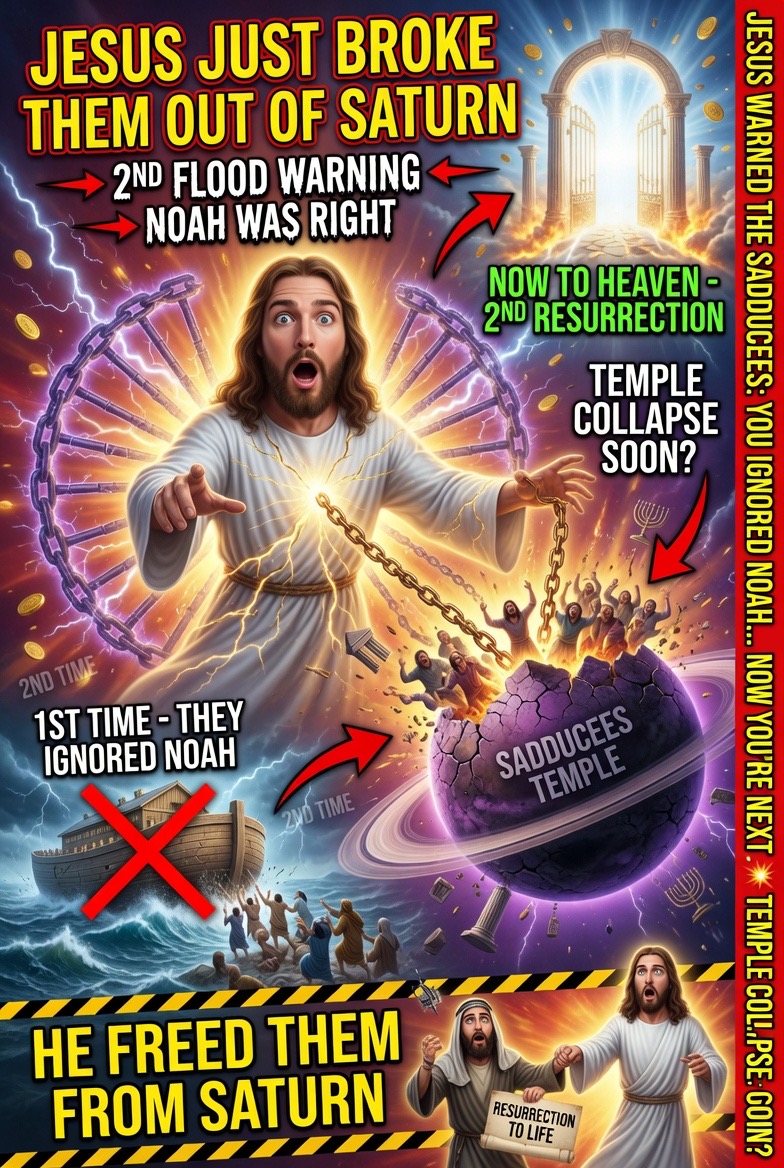
The Ark of Salvation: From Sheol to the New Jerusalem
I. The Descent into Hell and the Proclamation of Victory
In the First Epistle of Peter, we encounter one of the most mysterious and powerful declarations in all of Scripture:
“For Christ also suffered once for sins, the righteous for the unrighteous, that he might bring us to God, being put to death in the flesh but made alive in the spirit, in which he went and proclaimed to the spirits in prison, because they formerly did not obey, when God’s patience waited in the days of Noah, while the ark was being prepared, in which a few, that is, eight persons, were brought safely through water.” — 1 Peter 3:18-20
And further:
“For this is why the gospel was preached even to the dead, that though judged in the flesh the way people are, they might live in the spirit the way God does.” — 1 Peter 4:6
The descent of Christ into Hell—known in the tradition as the Harrowing of Hell—stands as a pivotal moment in salvation history. This is not a descent of defeat but of triumph. Christ did not go to the realm of the dead to suffer but to liberate, to announce the victory of the Cross to those who had waited in faith.
The Eight Saved and the World Condemned
In the days of Noah, the entire world had given itself over to wickedness. Genesis 6:5 tells us that “the Lord saw that the wickedness of man was great in the earth, and that every intention of the thoughts of his heart was only evil continually.” Out of all humanity, only eight souls—Noah, his wife, his three sons, and their wives—found grace in the eyes of the Lord.
This is a staggering statistic. The entire antediluvian world, numbering in the millions potentially, perished. They had the preaching of Noah, a “herald of righteousness” (2 Peter 2:5), yet they refused to believe. They mocked. They scoffed. They continued in their violence and corruption until the flood came and swept them all away.
Jesus Himself used this as a warning:
“For as in those days before the flood they were eating and drinking, marrying and giving in marriage, until the day when Noah entered the ark, and they were unaware until the flood came and swept them all away, so will the coming of the Son of Man be.” — Matthew 24:38-39
The flood was not merely a natural disaster—it was divine judgment upon a world that had rejected its Creator. The eight who entered the ark entered through faith. The ark itself becomes a type of the Church: the vessel of salvation amidst the waters of destruction.
Christ’s Proclamation to the Spirits in Prison
When Christ descended into the realm of the dead, He made a threefold proclamation:
To the righteous who had believed: He announced the victory of the Cross and their imminent liberation. These were the patriarchs, prophets, and holy ones who had died in faith, awaiting the fulfillment of God’s promises.
To those who had refused to believe: He proclaimed the justice of their condemnation. His very presence demonstrated what they had rejected—the Son of God had indeed come, and they had refused Him.
To the fallen angels: He declared His absolute triumph over the powers of darkness, shaming them publicly (Colossians 2:15).
The ancient homily read in the Liturgy of the Hours on Holy Saturday captures this magnificently:
“I am your God, who for your sake have become your son. Out of love for you and for your descendants I now by my own authority command all who are held in bondage to come forth, all who are in darkness to be enlightened, all who are sleeping to arise. I order you, O sleeper, to awake. I did not create you to be held a prisoner in hell. Rise from the dead, for I am the life of the dead.”
II. Abraham’s Bosom and the Realms of Sheol
The Hebrew Understanding of the Afterlife
The ancient Hebrews understood Sheol as the realm of the dead—a shadowy existence beneath the earth where all the dead went, both righteous and wicked. Sheol was not heaven or hell as we understand them, but rather a waiting place, a realm of shadows where the dead existed in a diminished state.
The Psalms frequently reference Sheol:
“For you will not abandon my soul to Sheol, or let your holy one see corruption.” — Psalm 16:10
“If I ascend to heaven, you are there! If I make my bed in Sheol, you are there!” — Psalm 139:8
Over time, Jewish understanding developed to recognize distinct regions within Sheol. By the Second Temple period, Jewish thought had developed the concept of different compartments within the underworld:
Abraham’s Bosom (or Paradise): The region where the righteous dead awaited the Messiah in comfort
The region of torment: Where the wicked suffered and awaited final judgment
This is precisely the picture Jesus presents in the Parable of the Rich Man and Lazarus (Luke 16:19-31):
“The poor man died and was carried by the angels to Abraham’s side. The rich man also died and was buried, and in Hades, being in torment, he lifted up his eyes and saw Abraham far off and Lazarus at his side.”
Abraham’s Bosom: Waiting for the Fulfillment
Abraham’s Bosom represents the state of the righteous dead before the coming of Christ. They were not yet in heaven, for heaven was not yet opened. The sacrifice that would make heaven accessible had not yet been offered. They waited in faith, sustained by the hope of God’s promises.
The author of Hebrews captures this beautifully:
“These all died in faith, not having received the things promised, but having seen them and greeted them from afar, and having acknowledged that they were strangers and exiles on the earth… And all these, though commended through their faith, did not receive what was promised, since God had provided something better for us, that apart from us they should not be made perfect.” — Hebrews 11:13, 39-40
When Christ descended, He liberated these holy ones. The gates of heaven were opened. The righteous who had waited—Abraham, Isaac, Jacob, Moses, David, the prophets, and all who had died in faith—were brought into the presence of God.
This is why we read in Matthew 27:52-53:
“The tombs also were opened. And many bodies of the saints who had fallen asleep were raised, and coming out of the tombs after his resurrection they went into the holy city and appeared to many.”
III. St. Alphonsus Liguori and the Reality of Hell
The Doctor of the Church on Eternal Punishment
St. Alphonsus Liguori (1696-1787), the great moral theologian and Doctor of the Church, wrote extensively on the reality of hell. In his masterwork “Preparation for Death” and other writings, he provided some of the most vivid and terrifying descriptions of eternal punishment in the Catholic tradition.
St. Alphonsus emphasizes two primary pains of hell:
The Pain of Sense
The pain of sense involves the physical torments of hell. St. Alphonsus, following the tradition and the words of Christ Himself, describes a fire that is real but different from earthly fire—a fire that burns but does not consume, that torments both body and soul.
He writes:
“The fire of hell is a fire that is entirely different from our fire. The fire of this world burns only when it has fuel; but the fire of hell burns without fuel. The fire of this world gives light; but the fire of hell gives no light, and on this account hell is called a land of darkness and misery. The fire of this world burns only the body; but the fire of hell burns both body and soul.”
The Pain of Loss
More terrible than the pain of sense is the pain of loss—the eternal deprivation of the Beatific Vision of God. St. Alphonsus writes:
“The pain of loss is the greatest pain in hell. The damned shall forever see that they have lost God, and shall know that they have lost Him through their own fault.”
This pain is compounded by the knowledge that:
God is infinitely good and desirable
He was offered to them freely
They rejected Him willfully
Their loss is absolute and eternal
The Eternity of Hell
St. Alphonsus emphasizes with great force the eternity of hell’s punishments. This is not a temporary purgation but an unending state:
“If hell were not eternal, it would not be hell. A man who is in prison for twenty years, however great his pain, finds some comfort in the thought that his imprisonment will end. But the damned have no such comfort. Their prison is forever.”
He further notes that the damned would not want to leave hell even if they could, for their wills have become fixed in opposition to God. They have confirmed themselves in their rejection.
The Reason for Such Terrible Punishment
St. Alphonsus explains that the severity of hell’s punishment corresponds to the infinite dignity of the One who is offended:
“Mortal sin is an injury offered to God. Now, the malice of an injury is measured by the dignity of the person offended. But God is of infinite dignity; therefore, an injury offered to God is of infinite malice; and consequently, since the punishment should be according to the malice, the punishment of mortal sin should be infinite.”
IV. The Glory of Heaven Present and Future
The Current State of the Blessed
Heaven, as it exists now, is the state of perfect union with God—the Beatific Vision. The souls of the just, having been purified, see God “face to face” (1 Corinthians 13:12). They experience:
The Vision of God: The direct, immediate knowledge of God in His essence. This is not mere intellectual knowledge but a transforming encounter. As St. John writes: “Beloved, we are God’s children now, and what we will be has not yet appeared; but we know that when he appears we shall be like him, because we shall see him as he is” (1 John 3:2).
Perfect Joy: The joy of heaven exceeds anything we can imagine. As St. Paul says, “What no eye has seen, nor ear heard, nor the heart of man imagined, what God has prepared for those who love him” (1 Corinthians 2:9).
The Communion of Saints: The blessed enjoy perfect fellowship with all the redeemed, with the angels, and above all with God.
Fulfillment of Desire: Every legitimate desire is satisfied in God. The restless heart finds its rest.
The New Heaven and New Earth
Yet the current state of heaven is not the final state. Scripture promises a cosmic renewal:
“Then I saw a new heaven and a new earth, for the first heaven and the first earth had passed away, and the sea was no more.” — Revelation 21:1
At the end of time, after the General Judgment, there will be a renewal of all creation. The New Heaven and New Earth will be the final and eternal state of glory.
The New Jerusalem
The Book of Revelation describes the New Jerusalem coming down from God:
“And I saw the holy city, new Jerusalem, coming down out of heaven from God, prepared as a bride adorned for her husband.” — Revelation 21:2
This New Jerusalem is both a place and a people—the Church in her final glory. Its characteristics include:
God’s Dwelling: “Behold, the dwelling place of God is with man. He will dwell with them, and they will be his people, and God himself will be with them as their God” (Revelation 21:3).
No More Suffering: “He will wipe away every tear from their eyes, and death shall be no more, neither shall there be mourning, nor crying, nor pain anymore, for the former things have passed away” (Revelation 21:4).
The Glory of God: The city has no need of sun or moon, for the glory of God gives it light, and the Lamb is its lamp (Revelation 21:23).
The River of Life: “Then the angel showed me the river of the water of life, bright as crystal, flowing from the throne of God and of the Lamb” (Revelation 22:1).
The Tree of Life: Bearing fruit each month, with leaves for the healing of the nations (Revelation 22:2).
The Timeline of Eschatological Events
The Catholic understanding of the timeline of final events proceeds as follows:
Individual Judgment: At death, each soul faces particular judgment and enters heaven (perhaps after purgation), hell, or—traditionally—the limbo of the infants.
The Present Time: We currently live in the age of the Church, where the Gospel is preached to all nations.
The Tribulation: Before the end, there will be a time of great trial for the Church.
The Second Coming: Christ will return in glory to judge the living and the dead.
The General Judgment: All the dead will be resurrected, and all will be judged publicly before the assembled nations.
The Renewal of Creation: The universe itself will be liberated from its bondage to decay (Romans 8:21).
The New Heaven and New Earth: The final and eternal state of glory.
We go to heaven now at death (if we are saved), but we await the resurrection of the body. The soul experiences the Beatific Vision immediately, but the complete fulfillment of human nature—body and soul united—awaits the General Resurrection.
V. North Sentinel Island and the Problem of Invincible Ignorance
The Hidden World
North Sentinel Island, located in the Bay of Bengal, is home to the Sentinelese—one of the last uncontacted peoples on Earth. They have violently resisted contact with the outside world, most famously killing American missionary John Allen Chau in 2018 when he attempted to bring the Gospel to them.
The Sentinelese live in a Stone Age condition, with no knowledge of modern technology, world history, or—most significantly—the Gospel of Jesus Christ. They practice animism, worshiping spirits and living in accordance with traditions passed down through millennia.
What They Are Missing
From the perspective of the Catholic faith, the Sentinelese are missing:
The Knowledge of the True God: They do not know the God who created them, loves them, and desires their salvation.
The Revelation of Christ: They have never heard the name of Jesus. They do not know of His Incarnation, His death, His Resurrection.
The Sacraments: They have no access to Baptism, the Eucharist, Confession, or any of the means of grace Christ instituted.
The Moral Law in Its Fullness: While they have the natural law written on their hearts (Romans 2:14-15), they lack the fullness of moral teaching that comes from divine revelation.
The Hope of Heaven: They live and die without the explicit knowledge of the hope of eternal life.
Invincible Ignorance and Salvation
The Catholic Church teaches that those who, through no fault of their own, do not know the Gospel of Christ or His Church, but who nevertheless seek God with a sincere heart and, moved by grace, try to do His will as they know it through conscience, can achieve eternal salvation (Catechism of the Catholic Church 847, citing Lumen Gentium 16).
This is not a denial of the necessity of Christ for salvation—extra ecclesiam nulla salus (outside the Church there is no salvation)—but a recognition that God’s grace can work in ways known to Him alone. Those who are saved through invincible ignorance are saved by Christ, through His Church, even if they do not explicitly know Him.
However, this truth should not make us complacent about evangelization. The Church still has the obligation to preach the Gospel to all nations (Matthew 28:19-20), for:
Faith comes by hearing (Romans 10:14-15)
The ordinary means of salvation are the sacraments
Those in invincible ignorance face great difficulties in living a moral life
The fullness of truth and grace is found in the Church
African Tribes, Isolated Peoples, and Those in Cults
The same principle applies to isolated tribes in Africa, the Amazon, and elsewhere, as well as to those trapped in false religious systems through no fault of their own.
Many African tribal religions contain semina Verbi—seeds of the Word—that point toward the true God. The traditional African concept of a Supreme Being, the reverence for ancestors, the sense of the sacred, the understanding of community—these can be starting points for the Gospel.
Those in cults and non-Catholic religions often have partial truths mixed with errors. The Catholic Church recognizes that elements of truth and sanctification exist outside her visible boundaries (Unitatis Redintegratio 3), but these elements find their fullness only in the Catholic Church.
The tragedy is that many people live and die without ever hearing the Gospel proclaimed clearly, or they are actively prevented from seeing it by those who should be witnesses. This makes the Church’s missionary mandate all the more urgent.
VI. Compassion Toward the Jewish People
The Elder Brothers in Faith
The Jewish people hold a unique place in salvation history. As St. Paul writes:
“They are Israelites, and to them belong the adoption, the glory, the covenants, the giving of the law, the worship, and the promises. To them belong the patriarchs, and from their race, according to the flesh, is the Christ, who is God over all, blessed forever. Amen.” — Romans 9:4-5
The Church’s relationship to the Jewish people is not like her relationship to any other religion. Judaism is the root from which Christianity grew. The Old Covenant was the preparation for the New. The Jewish people gave us the Scriptures, the patriarchs, the prophets, and above all, the Messiah Himself.
The Fear and Faithfulness of the Jewish People
The Jewish people have survived millennia of persecution, exile, and attempted extermination. Their fidelity to Yahweh, to the Torah, and to the covenant—despite unimaginable suffering—is a testimony that should command respect.
When we consider Jewish history—the Egyptian bondage, the Babylonian exile, the Roman destruction of Jerusalem, the centuries of diaspora, the Inquisition, the pogroms, the Holocaust—we can understand why there is a profound wariness, a fear rooted in historical experience.
The Jewish people were warned by God through the prophets that exile and suffering would follow covenant infidelity. They experienced the fulfillment of these warnings. But they also received the promise of restoration, and they clung to that promise through centuries of darkness.
Showing Them the One God We Worship
The Catholic Church worships the same God as the Jewish people—the God of Abraham, Isaac, and Jacob. When we speak of the Trinity, we are not speaking of three gods but of one God in three Persons. This is the same God who revealed Himself to Moses as “I AM WHO I AM” (Exodus 3:14).
The challenge for Jewish-Catholic dialogue is to show that Jesus is not a departure from monotheism but its fulfillment. The New Covenant does not abolish the Old but brings it to completion.
As St. Paul teaches in Romans 11, the Jewish people have not been rejected by God. Their temporary hardening has served to bring the Gospel to the Gentiles, but this is not the end of the story:
“And even they, if they do not continue in their unbelief, will be grafted in, for God has the power to graft them in again. For if you were cut from what is by nature a wild olive tree, and grafted, contrary to nature, into a cultivated olive tree, how much more will these, the natural branches, be grafted back into their own olive tree.” — Romans 11:23-24
“And in this way all Israel will be saved” — Romans 11:26
The Demand for Loyalty to Yahweh
The Jewish people’s loyalty to Yahweh, even in the face of what Christians see as the revelation of the Messiah, is not simply stubbornness. It is a fidelity born of deep conviction and centuries of experience.
We must imitate this loyalty. In an age of syncretism, relativism, and religious consumerism, the commitment of the Jewish people to the one true God is a rebuke. They have refused to dilute their faith, refused to accommodate themselves to every passing philosophical fashion.
As Catholics, we must be equally loyal to Yahweh—Father, Son, and Holy Spirit. We must hold fast to the faith once delivered to the saints, even as we engage with each new generation and make use of new technologies to spread the Gospel.
The newer generation and technology are not enemies of the faith but tools for its proclamation. The same God who spoke through burning bushes and inscribed commandments on stone now speaks through websites and social media. The message is the same; the medium changes.
VII. The Ark of Salvation: The Roman Catholic Church
The Church as Ark
The Church has always understood herself as the Ark of Salvation. Just as Noah’s Ark preserved eight souls through the flood, the Church preserves the faithful through the flood of sin and death.
St. Cyprian of Carthage famously declared: “Extra ecclesiam nulla salus”—outside the Church there is no salvation. This teaching has been repeatedly affirmed by the Council of Florence, Pope Boniface VIII in Unam Sanctam, and the Second Vatican Council.
The Church is the Ark because:
She possesses the fullness of truth: The Catholic Church alone has preserved the complete deposit of faith, without addition or subtraction.
She possesses the fullness of the sacraments: All seven sacraments, instituted by Christ and entrusted to the Church, are means of grace that cannot be found elsewhere in their fullness.
She possesses the apostolic succession: The unbroken line from the apostles to the present ensures the continuity of teaching authority.
She is the Body of Christ: The Church is not merely an institution but a mystical reality—the continuation of Christ’s presence on earth.
The Necessity of the Church for Salvation
This does not mean that everyone who is visibly outside the Church is necessarily damned. As discussed earlier, invincible ignorance can be a condition that mitigates personal responsibility. But it does mean that:
All salvation comes through Christ
Christ has willed that salvation be mediated through His Church
Those who knowingly and willingly reject the Church place their salvation in jeopardy
The ordinary and normative means of salvation are found within the Church
Accepting Jews for Conversion
The Catholic Church has always prayed for the conversion of the Jewish people—not through coercion or force (which are condemned), but through the gentle persuasion of truth and love.
The conversion of the Jews is not a denial of their dignity but its fulfillment. As St. Paul teaches, the Jewish people are the natural branches of the olive tree. Their grafting back in is not something foreign to their nature but the completion of it.
The Church’s approach to Jewish conversion must be:
Respectful: Acknowledging the Jewish people’s unique role in salvation history
Honest: Not hiding the truth that Christ is the Messiah and the Church is His Body
Patient: Recognizing that conversion is ultimately the work of the Holy Spirit
Loving: Motivated by genuine concern for the salvation of souls, not by triumphalism
VIII. The Errors of Non-Catholic Religions
New Age Spirituality
The New Age movement represents a syncretistic blend of Eastern spirituality, Western occultism, and psychological self-help. Its fundamental errors include:
Pantheism: The belief that everything is God and God is everything, denying the distinction between Creator and creation.
Reincarnation: The belief in successive earthly lives, contradicting “it is appointed for man to die once, and after that comes judgment” (Hebrews 9:27).
Self-Deification: The belief that the self is divine or can become divine through spiritual practices, apart from grace.
Relativism: The denial of objective truth, reducing all religious claims to subjective experience.
Occult Practices: Involvement with channeling, astrology, crystals, and other practices that open the door to spiritual deception.
New Age spirituality is ultimately a repackaging of the original temptation: “You shall be as gods” (Genesis 3:5).
Islam
Islam acknowledges Jesus as a prophet but denies:
His Divinity: Islam categorically rejects that Jesus is God, the Second Person of the Trinity.
His Crucifixion: Islam teaches that Jesus was not crucified but was taken up to heaven, with someone else substituted in His place.
The Trinity: Islam considers Trinitarian belief to be polytheism.
The Redemption: Without the Cross, there is no atoning sacrifice for sin.
While Islam shares with Christianity belief in one God, prophetic revelation, and a final judgment, its denial of Christ’s divinity and redemptive death places it fundamentally outside the truth of the Gospel.
Hinduism
Hinduism encompasses a wide variety of beliefs, but its core errors include:
Polytheism: Despite philosophical tendencies toward monism, Hinduism in practice involves the worship of many gods.
Reincarnation and Karma: The cycle of death and rebirth, governed by karma, contradicts the Christian understanding of one life followed by judgment.
Illusion (Maya): The concept that the material world is ultimately illusory denies the goodness of creation.
No Personal God in the Christian Sense: While Hinduism has personal deities, ultimate reality (Brahman) is often understood as impersonal.
No Concept of Sin and Redemption: Hinduism lacks the understanding of original sin and the need for a redeemer.
Buddhism
Buddhism, in its various forms, teaches:
No God: Original Buddhism is non-theistic, denying the existence of a personal Creator.
The Four Noble Truths and the Eightfold Path: While containing moral wisdom, these are presented as a self-salvation project rather than response to divine grace.
Nirvana: The goal is not union with God but the extinguishing of desire and the cessation of existence as we know it.
Annatta (No-Self): The denial of a permanent soul contradicts the Christian understanding of the immortal soul made in God’s image.
All Non-Catholic Religion
While elements of truth can be found in all religions—as the Second Vatican Council acknowledged—these elements are incomplete and often mixed with error. The fullness of truth subsists in the Catholic Church alone.
This is not arrogance but realism. If Christ is who He says He is, and if the Church is what He established, then to withhold this truth would be the opposite of love.
IX. Saturn, the Entrapment of Souls, and Spiritual Warfare
Saturn and the Kingdom of Darkness
In ancient mythology, Saturn (the Roman equivalent of the Greek Cronus) was the god who devoured his own children. He represents the forces of restriction, time, death, and oppression.
Some Church Fathers and later Christian commentators saw in Saturn a type or symbol of Satan himself—the one who holds humanity in bondage. The connection between Saturn and Saturday (the Sabbath) has been noted by various commentators throughout history.
The Sabbath was given as a gift to Israel—a sign of the covenant and a participation in God’s rest. However, the New Testament reveals that the Sabbath finds its fulfillment in Christ, who is our true Sabbath rest (Hebrews 4:1-11). The early Church, under the guidance of the apostles, moved the primary day of worship to Sunday—the Lord’s Day—the day of Resurrection.
The Entrapment of Souls
Satan’s primary work is the entrapment of souls. He operates through:
Deception: “He was a murderer from the beginning, and does not stand in the truth, because there is no truth in him. When he lies, he speaks out of his own character, for he is a liar and the father of lies” (John 8:44).
Accusation: He is “the accuser of our brothers” (Revelation 12:10), constantly bringing up our sins before God and driving us to despair.
Temptation: He presents sin as desirable and hides its consequences.
Oppression and Possession: In more extreme cases, he directly afflicts individuals.
False Religion: He promotes counterfeit spiritualities that lead souls away from the truth.
The entrapped soul is one that has been caught in the snares of these deceptions and cannot free itself by its own power. Only Christ can liberate such a soul.
X. A Message to Roman Catholics
The Privilege and Responsibility
To be a Roman Catholic is to have received the greatest spiritual inheritance possible on earth. The fullness of truth, the fullness of grace, the fullness of the means of salvation—these have been entrusted to you.
But this privilege brings with it a corresponding responsibility:
“Everyone to whom much was given, of him much will be required, and from him to whom they entrusted much, they will demand the more” (Luke 12:48).
The Temptation to Complacency
It is possible to be sacramentalized without being evangelized. It is possible to go through the motions of Catholic practice without ever encountering the living Christ. The greatest danger to Catholics is not persecution from without but complacency from within.
The Lord’s harshest words were not for prostitutes and tax collectors but for the religious leaders who had the truth but did not live it. The same danger faces Catholics today.
The Call to Holiness
The Second Vatican Council’s universal call to holiness is a reminder that every Catholic—not just priests and religious—is called to sanctity. This requires:
A life of prayer: Daily communion with God through both liturgical and personal prayer.
Regular confession: The frequent use of the Sacrament of Reconciliation.
Eucharistic devotion: Frequent reception of Holy Communion, preceded by proper preparation.
Study of the faith: Knowing what we believe and why we believe it.
Evangelization: Sharing the faith with others through both word and example.
Works of mercy: Serving Christ in the poor, the sick, and the marginalized.
The Danger of Taking the Church for Granted
Many Catholics treat the Church as a convenience—something to be used for weddings, funerals, and major holidays, but not something that demands their full allegiance. This is a profound error.
The Church is not a social club. She is the Bride of Christ, the Pillar and Foundation of Truth (1 Timothy 3:15), the Ark of Salvation. To treat her lightly is to despise the gift of God.
XI. A Message to Non-Catholics
The Sincerity That Is Not Enough
Many non-Cath Christians are sincere in their faith. They love the Lord, they study the Scriptures, they seek to live holy lives. Sincerity, however, is not a substitute for truth.
St. Paul speaks of his Jewish brethren: “Brothers, my heart’s desire and prayer to God for them is that they may be saved. For I bear them witness that they have a zeal for God, but not according to knowledge” (Romans 10:1-2).
The same can be said of many non-Catholic Christians: they have zeal, but they lack the fullness of the faith.
The Invitation
The Catholic Church does not invite non-Catholics to abandon their love for Christ but to deepen it. She does not ask them to reject the truth they have received but to receive more truth.
The Church is the home Christ established for all His disciples. He prayed “that they may all be one” (John 17:21), and that unity can only be found in the visible unity of the Church.
XII. A Critical Examination: The Jewish People and the Church
The Arrogance and Ignorance That Must Be Addressed
It must be said with sorrow that there have been, and continue to be, elements of Jewish religious leadership that demonstrate a profound arrogance and willful ignorance regarding the claims of Christianity.
This is not a condemnation of the Jewish people as a whole—God forbid! It is an acknowledgment that religious leadership, in any tradition, can become entrenched in error and resistant to truth.
The arrogance manifests in:
The dismissal of Jesus as a false messiah without seriously engaging with the evidence for His Resurrection and the fulfillment of prophecy.
The characterization of Christian Trinitarian belief as polytheism, despite two millennia of explanation that the Trinity is monotheistic.
The refusal to engage with the New Testament as a serious Jewish text that emerges from the Jewish tradition.
The perpetuation of historical caricatures of Christian belief and practice.
This is not unique to Judaism—every religious tradition has its blind spots and its defensive reflexes. But it is particularly tragic in the case of the Jewish people, who were the original recipients of the promises that find their fulfillment in Christ.
The Errors of Jewish Rejection
The Jewish rejection of Jesus as Messiah rests on several errors:
A misunderstanding of messianic prophecy: The expectation of a purely political and military messiah who would restore the earthly kingdom of Israel misses the deeper prophecies of a suffering servant who would bear the sins of many (Isaiah 53).
A failure to recognize the New Covenant: Jeremiah 31:31-34 explicitly promises a new covenant, different from the one made at Sinai. The Christian claim is that this new covenant has been established in Christ.
An overemphasis on Torah observance: While the Torah is holy and good, it was always meant to be preparatory—a tutor to lead us to Christ (Galatians 3:24-25).
The authority of the Talmud over Scripture: In many forms of Judaism, the Talmud and later rabbinic authorities have precedence over the plain meaning of Scripture.
A Call to Honesty
Honesty requires that both Jews and Christians acknowledge the complexities of their relationship. Christians must acknowledge the terrible history of Christian anti-Semitism, the forced conversions, the Inquisitions, the pogroms, and the complicity of many Christians in the Holocaust.
Jews must acknowledge that the rejection of Jesus was not merely a difference of interpretation but a rejection of God’s appointed Messiah, with consequences that have echoed through history.
Both sides must approach one another with humility, recognizing that we are dealing with matters of eternal significance that cannot be reduced to mere cultural differences.
XIII. A Critical Examination: Roman Catholic Errors Regarding the Chosen People
The Marian Doctrine and Its Implications
The Catholic Church’s Marian doctrines—while true and necessary—have been presented in ways that can seem to disqualify the Jewish people from their unique covenant relationship with God.
Mary is indeed the Ark of the New Covenant. Just as the Ark of the Old Covenant held the manna, the tablets of the Law, and Aaron’s rod, so Mary held within her womb the true Manna from Heaven, the Lawgiver Himself, and the Eternal High Priest.
But this typology, properly understood, does not replace Israel—it fulfills Israel. Mary herself is a daughter of Israel, the culmination of all the faith and hope of the Jewish people. She is not a replacement for Israel but Israel’s greatest flower.
The Trinitarian Doctrine and Jewish Monotheism
The doctrine of the Trinity has been a stumbling block for Jewish people, who see it as a violation of the Shema: “Hear, O Israel: The Lord our God, the Lord is one” (Deuteronomy 6:4).
The Church must do a better job of explaining that:
The Trinity is not tritheism: We do not believe in three gods but in one God in three Persons.
The Trinity is revealed in the Hebrew Scriptures: Hints of plurality within the Godhead can be found in Genesis 1:26 (“Let us make man in our image”), Genesis 18 (the three visitors to Abraham), Proverbs 8 (Wisdom personified), and many other passages.
The Trinity makes sense of God’s love: If God is love (1 John 4:8), then there must be an object of love within the Godhead from all eternity. A Unitarian God would need creation in order to love, making creation necessary rather than gratuitous.
The Error of Disqualification
The gravest error that some Catholics have made is to teach that the Jewish covenant has been completely replaced and nullified by the New Covenant—that the Jewish people are no longer the chosen people in any sense.
This is contradicted by St. Paul:
“As regards the gospel, they are enemies for your sake. But as regards election, they are beloved for the sake of their forefathers. For the gifts and the calling of God are irrevocable.” — Romans 11:28-29
The Jewish people retain their election, even if they have not yet recognized its fulfillment in Christ. The Church has not replaced Israel but has been grafted into Israel. We are the wild olive branches, not the root.
The New Chosen People
It is true that the Church is the new Israel, the new People of God. This is not a replacement but an expansion. Through Christ, the covenant has been opened to all nations. The criteria for membership in the chosen people is no longer ethnic but spiritual—faith in Christ and incorporation into His Body through Baptism.
But this does not mean that ethnic Israel has lost all significance. As St. Paul teaches, there is a future conversion of the Jewish people that will be like “life from the dead” (Romans 11:15).
XIV. Mary as the Ark of the New Covenant
The Typology
The Ark of the Old Covenant was the most sacred object in Israel’s worship. It held:
The Manna: The bread from heaven that sustained Israel in the wilderness.
The Tablets of the Law: The Ten Commandments given to Moses on Mount Sinai.
Aaron’s Rod: The rod that budded, signifying the legitimate priesthood.
Mary, as the Ark of the New Covenant, held within her womb:
The True Manna from Heaven: Jesus, the Bread of Life (John 6:48-51).
The Lawgiver Himself: Jesus, who gave the new law of love (John 13:34).
The Eternal High Priest: Jesus, the priest according to the order of Melchizedek (Hebrews 5:6).
The parallels between the Ark and Mary are striking:
The Ark was overshad by God’s presence (Exodus 40:34-35); Mary was overshad by the Holy Spirit (Luke 1:35).
The Ark was kept pure and holy, touched only by the appointed priests; Mary was kept pure from all sin, full of grace.
David leapt and danced before the Ark (2 Samuel 6:14-16); John the Baptist leapt in Elizabeth’s womb at Mary’s arrival (Luke 1:41-44).
The Ark was taken to the house of Obed-edom, who was blessed (2 Samuel 6:10-11); Mary went to the house of Elizabeth, who was blessed (Luke 1:39-45).
Mary as the Ark of Salvation
Just as the Ark of the Old Covenant was the sign of God’s presence and protection, Mary is the Ark of the New Covenant—the sign that God has truly dwelt among us.
Mary is not the Ark of Salvation in herself—she is not the Savior. But she is the vessel that carried the Savior, and through her maternal intercession, she continues to draw souls to her Son.
The Catholic Church, which is the Ark of Salvation in the order of society, has Mary as its most glorious member and its preeminent intercessor. The Church and Mary are inseparable: the Church is the Body of Christ, and Mary is the Mother of that Body.
XV. Conclusion: The Urgency of the Message
The Stakes Are Eternal
The message of salvation is not a matter of intellectual curiosity—it is a matter of eternal life or eternal death. Hell is real. Heaven is real. The choice we make in this life determines our destiny forever.
Those who have never heard the Gospel—like the Sentinelese, like isolated tribes, like those trapped in false religions through no fault of their own—are not beyond God’s mercy. But those who have heard the Gospel and refuse to believe stand under a greater judgment.
The Call to Faithfulness
We must be faithful to Yahweh—the God of Abraham, Isaac, and Jacob—who has revealed Himself fully in Jesus Christ. This faithfulness requires:
Orthodoxy: Holding fast to the true faith, without compromise or dilution.
Orthopraxy: Living out the faith in love, mercy, and justice.
Evangelization: Proclaiming the Gospel to all nations, beginning with the Jewish people.
Hope: Trusting in God’s promises, even when we cannot see their fulfillment.
The New Heaven and New Earth Are Coming
The present heaven is glorious beyond comprehension, but it is not the end. The new heaven and new earth are coming. The New Jerusalem will descend. The dead will be raised. The body and soul will be reunited. Creation itself will be liberated from its bondage to decay.
This is our hope. This is what we live for. This is what we proclaim.
May the Lord Jesus Christ, who descended into hell to liberate the captives, who reigns in heaven at the right hand of the Father, and who will come again in glory to judge the living and the dead—may He grant us all the grace to persevere in faith, to proclaim His Gospel with boldness, and to enter into His eternal kingdom.
Amen.
For further reading:
Catechism of the Catholic Church, sections on Christ’s descent into hell (632-637), heaven (1023-1029), and hell (1033-1037)
St. Alphonsus Liguori, Preparation for Death
Vatican II, Nostra Aetate (Declaration on the Relation of the Church to Non-Christian Religions)
Vatican II, Lumen Gentium (Dogmatic Constitution on the Church)
John Paul II, Ecclesia in Europa (Apostolic Exhortation)
Joseph Ratzinger (Benedict XVI), Eschatology: Death and Eternal Life
The Jewish People and Their Sacred Scriptures in the Christian Bible (Pontifical Biblical Commission)
Leave a Reply